The announcement, made through the Presidency Communications Office on Tuesday, June 30, 2026, demonstrates the government's commitment to providing urgent assistance to affected communities while implementing measures to reduce the impact of future flooding.
Government's Immediate Response
According to the presidential directive, the GH₵300 million package will be distributed into two major intervention areas:
| Allocation | Amount |
|---|---|
| Emergency Relief for Flood Victims | GH₵150 million |
| Flood Mitigation and Prevention Measures | GH₵150 million |
| Total | GH₵300 million |
The first half of the allocation will support emergency humanitarian interventions, including:
Provision of food supplies
Temporary accommodation for displaced families
Medical assistance
Clean drinking water
Emergency sanitation services
Distribution of relief items
Community recovery support
The second half will finance flood mitigation initiatives aimed at preventing similar disasters in the future.
Security Agencies Mobilised
President Mahama has also instructed the deployment of personnel from the:
Ghana Armed Forces
Ghana Police Service
National Disaster Management Organisation (NADMO)
Other national security agencies
These institutions are expected to work jointly in rescue operations, evacuation efforts, emergency response, and the delivery of humanitarian assistance to affected communities.
Their coordinated operations are already underway in flood-hit areas where residents continue to require urgent assistance.
Presidential Assessment
Earlier in the day, President Mahama undertook an aerial assessment of the affected areas to obtain firsthand information about the scale of destruction caused by the unusually heavy rainfall.
The aerial inspection enabled government officials to evaluate:
The extent of flooding
Damage to roads and bridges
Residential communities affected
Public infrastructure damage
Areas requiring immediate intervention
The President subsequently announced several measures aimed at safeguarding lives and strengthening Ghana's resilience against future flooding.
Why This Matters
Flooding remains one of Ghana's most persistent natural disasters, particularly in the Greater Accra Region and other urban centres where:
Rapid urbanisation has outpaced drainage infrastructure.
Buildings have been constructed within waterways and wetlands.
Poor waste disposal practices block drains.
Climate change has contributed to more intense rainfall events.
These factors continue to increase the frequency and severity of flooding across the country.
Expected Flood Mitigation Measures
Although government has not yet released a detailed implementation framework, the mitigation allocation is expected to support projects such as:
Construction and expansion of drainage systems
Desilting of major drains and rivers
Rehabilitation of damaged culverts
Improvement of storm-water infrastructure
Relocation of structures obstructing waterways
Strengthening early warning systems
Community education on flood preparedness
Environmental restoration initiatives
These investments aim to reduce the long-term economic and humanitarian costs associated with recurring floods.
Economic and Social Impact
Flood disasters often have significant consequences beyond the immediate loss of property. The recent flooding is expected to affect:
Households
Damage to homes and personal belongings
Temporary displacement
Loss of livelihoods
Businesses
Destruction of inventory
Business interruptions
Reduced economic activity
Infrastructure
Damaged roads
Disrupted transportation
Utility interruptions
Agriculture
Crop losses
Livestock deaths
Reduced food production in affected areas
Public Expectations
Citizens and civil society organisations are expected to closely monitor the utilisation of the GH₵300 million allocation to ensure:
Transparent disbursement of funds
Timely delivery of relief assistance
Fair distribution to affected communities
Effective implementation of mitigation projects
Accountability in procurement and project execution
Many stakeholders have also renewed calls for sustained investment in flood prevention rather than relying primarily on emergency responses after disasters occur.
Looking Ahead
The release of GH₵300 million represents one of the government's most significant emergency interventions in response to recent flooding. While the immediate relief package will help affected communities recover, experts stress that long-term solutions—including improved urban planning, stronger drainage systems, environmental protection, and enforcement of building regulations—will be essential to reducing Ghana's vulnerability to recurring floods.
As rescue and recovery efforts continue, the success of this intervention will depend on the speed, transparency, and effectiveness with which relief reaches those most affected and mitigation projects are implemented.
Official Statement Summary
The Presidency Communications Office stated that:
GH₵300 million has been released from the Contingency Fund.
GH₵150 million will support immediate flood relief.
GH₵150 million will fund flood mitigation measures.
The Ghana Armed Forces, Police, NADMO, and other security agencies have been deployed to support ongoing rescue and relief operations.
President Mahama personally conducted an aerial assessment of the affected areas before announcing additional measures to protect residents and prevent future flooding.
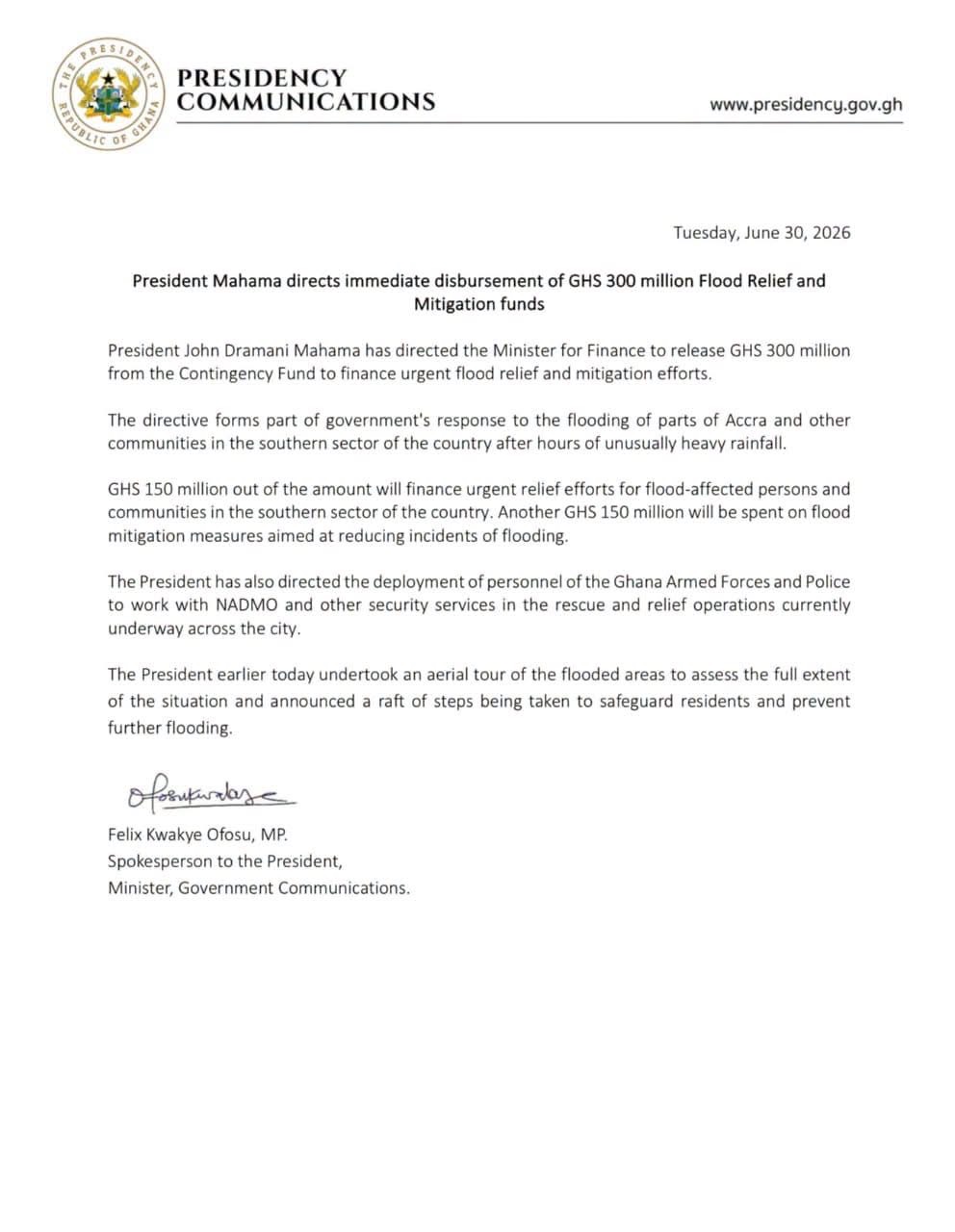
Source: Presidency Communications, Republic of Ghana (June 30, 2026).

Comments
No comments yet.