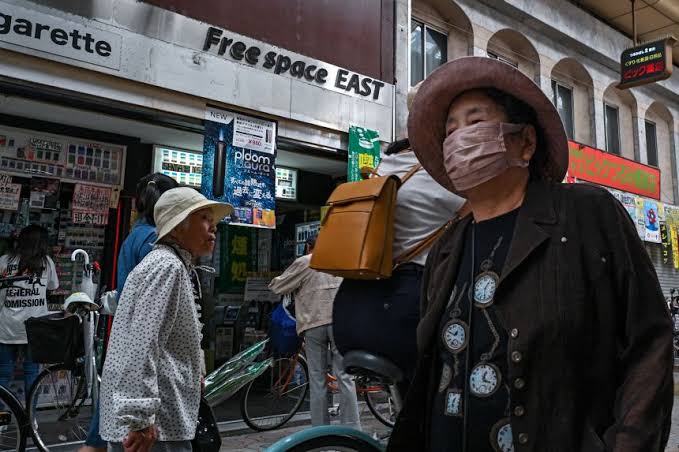
Not even heavy rain can keep shoppers away from Gikomba, a lively Kenyan market that stands as the largest open-air trading hub in East Africa.
The report indicates that not even heavy rain can keep shoppers away from Gikomba, a lively Kenyan market that stands as the largest open-air trading hub in East Africa.
It further notes that sections of the site were waterlogged on the day the BBC visited, yet shoppers, some wearing rubber boots, still inched their way through the congested pathways, hunting for Gikomba’s speciality – second-hand clothing.
The trade in garments imported from the US, Europe and China poses a perennial problem for the East African Community (EAC), a regional bloc of which Kenya is a member. How can the region build a thriving fashion industry when it is saturated with cheap cast-offs?
“We’re competing with second-hand clothing, but we can’t compete on price,” Zia Bett, founder of Kenyan womenswear brand Zia Africa, tells the BBC.
Elizabeth Paul, who owns Kuya Creations in Tanzania’s main city of Dar es Salaam, agrees: “In my shop, the minimum price of a dress is 50,000 Tanzanian shillings (£14.50; $19.20). People tell me: ‘For 50,000 I can get 10 second-hand dresses, so let me buy those.'”
A decade ago, the EAC decried the influx of second-hand clothing and was primed to impose a ban across its member states. After some strong-arming from the US, the proposal fell apart but now the debate has resurfaced.
Uganda, a country whose president once criticised second-hand clothing as coming from white “dead people”, has introduced an additional 30% tax on importsin an effort to boost the local garment industry and protect the environment.
Days later, the treasury in neighbouring Kenya attempted to change the way it taxed used clothing, saying its proposed system would simplify things for importers. But following a backlash from Kenyans worried that this would lead to price rises, the proposal was swiftly dropped from the Finance Bill.
In a bid to support homegrown clothing manufacturers, Kenya already applies a 30% customs duty to imports of used clothing – 5% more than it costs to ship in new clothes.
According to trade data platform the Observatory of Economic Complexity (OEC), Kenya is currently Africa’s leading importer of second-hand clothing or “mitumba” as they are known in Swahili.
The mitumba-loving nation received almost 180,000 tonnes of used clothing in 2022 – a 76% increase on the amount imported in 2013, UN trade data shows.
In neighbouring Uganda, second-hand clothes are the most sought-after garments, followed by imported new clothing and, lastly, locally manufactured clothing, the government-funded Economic Policy Research Centre found in 2024.
The new 30% environmental levy on used clothing comes on top of an existing 35% import duty and 18% VAT.
“The levy of 30% on worn clothing is intended to mitigate environmental degradation while promoting domestic production,” the bill says, according to local news outlet the Kampala Report.