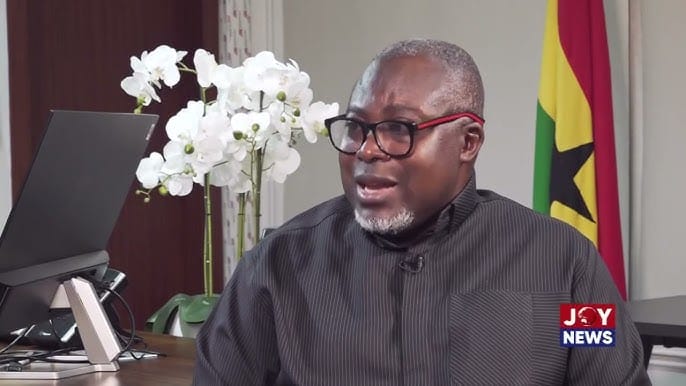
Economist and Professor of Finance at the University of Ghana Business School, Godfred Bokpin, has cautioned government against treating Ghana’s digital finance ecosystem mainly as
The report indicates that economist and Professor of Finance at the University of Ghana Business School, Godfred Bokpin, has cautioned government against treating Ghana’s digital finance ecosystem mainly as a tool for taxation.
It further notes that he says digital payments, fintech platforms and mobile money services should first be used to build an inclusive and productive economy.
Prof. Bokpin argues that if government places taxation ahead of the broader benefits of digitisation, consumers and businesses may respond negatively.
“We should not only look at it from the perspective of taxation. We should look at it in terms of the broader economic benefit. If you always put tax ahead of digitisation, the market will react differently,” he indicated.
Prof. Bokpin was speaking in a yet-to-be-aired documentary, “The Trust Crisis,” ahead of the maiden Digital Economy Forum under the theme, “The Trust Crisis: Why Fraud Is Holding Back Ghana’s Digital Economy.“
The thought-leadership platform, an initiative of Hubtel, will air on JoyNews and Joy FM on Wednesday, July 22, 2026, at 8 p.m.
The forum will bring together regulators, banks, fintech companies, telecommunications firms, security agencies and consumers to examine whether Ghana’s regulatory system is keeping pace with the growth of digital finance.
Prof. Bokpin stated Ghana’s large informal sector and unbanked population make digital finance critical to economic transformation.
“For a country like Ghana, with a huge informal sector and a huge unbanked population, these avenues allow the economy to rope in the unbanked, who traditionally would not be comfortable opening a bank account to do transactions,” he said.
He explained that many informal-sector workers struggle to meet the documentation requirements of conventional banking.
“These days, when you want to open a bank account, they still ask you for certain documents that the average Ghanaian in the informal sector may not be able to provide. So, digital payments, digital apps and fintech open up the market and rope in all these people,” he indicated.
According to him, the real value of digitisation lies in financial inclusion, greater transaction flows and a stronger foundation for economic activity.
“The real benefit is that it increases financial inclusion and helps to ensure that there is increased flow within the financial system, which can also aid intermediation. If government is able to put in place the right structure, we are able to trace transactions and formalise the informal sector in a certain way that allows us to build an inclusive economy,” he added.
Prof. Bokpin stated taxation should follow from a stronger and more formal economy, not be the first signal government sends to users of digital platforms.