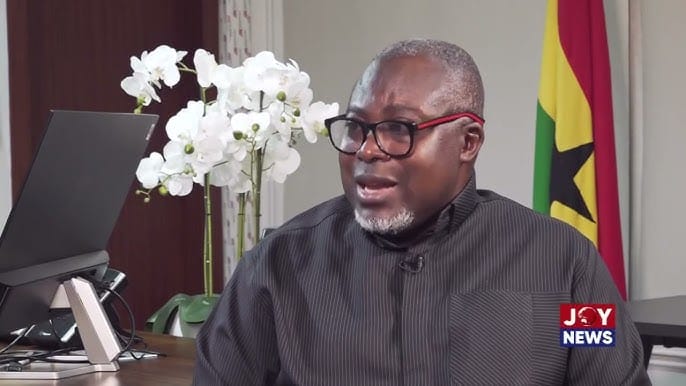
Economist and Professor of Finance at the University of Ghana Business School, Professor Godfred Bokpin, says digital fraud must not be treated only as a criminal matter because it
The report indicates that economist and Professor of Finance at the University of Ghana Business School, Professor Godfred Bokpin, says digital fraud must not be treated only as a criminal matter because its impact can weaken confidence, reduce participation in digital payments and slow economic growth.
It further notes that he says Ghana’s digital economy depends on trust and any sustained erosion of confidence could affect financial inclusion, formalisation, tax mobilisation and the country’s transition to a cash-lite economy.
Prof. Bokpin was speaking in a yet-to-be-aired documentary, “The Trust Crisis,” ahead of the maiden Digital Economy Forum under the theme, “The Trust Crisis: Why Fraud Is Holding Back Ghana’s Digital Economy.“
The thought-leadership platform, an initiative of Hubtel, will air on JoyNews and Joy FM on Wednesday, July 22, 2026, at 8 p.m.
The forum will bring together regulators, banks, fintech companies, telecommunications firms, security agencies and consumers to examine whether Ghana’s regulatory system is keeping pace with the growth of digital finance.
Prof. Bokpin stated digital fraud has both criminal and economic dimensions. He stated the growing “economy of fraud” means the law alone cannot solve the problem.
“It is very difficult to separate the two. It is a crime, but of course, it is also driven by economic reasons. There are those who invest to ensure that they benefit from this fraud because that is a kind of profession for them all over the world. The law alone does not solve that problem. You also need higher public education. Higher financial literacy also helps, so that people understand how they use it and how they can protect their passwords,” he said.
His comments come as fraud cases in Ghana’s financial sector continue to rise.
The Bank of Ghana’s 2024 fraud report shows that banks, specialised deposit-taking institutions and payment service providers recorded 16,733 fraud cases in 2024, up from 15,865 in 2023.
The total value at risk increased by 13 per cent, from GH¢88 million in 2023 to approximately GH¢99 million in 2024.
Payment service providers accounted for 94 per cent of total reported fraud cases, making digital-payment channels central to Ghana’s fraud challenge.
Prof. Bokpin stated fraud can change consumer behaviour and push people away from digital transactions. He cited traders who reject mobile money payments because of fraud concerns.
“We know that in Ghana, because of fraud associated with MoMo here and there, there are communities and traders who do not want to accept MoMo payment. It is simply because they do not have confidence in the system. It may also be because they have had one experience or another, directly or indirectly. One direct effect is unwillingness to participate. What that means is that they will prefer to do more cash-based transactions,” he said.
The economist stated when trust falls, participation in the digital economy also suffers. According to him, this has wider economic implications because digital payments can help reduce transaction costs, increase financial inclusion and bring more informal-sector activity into the formal financial system.