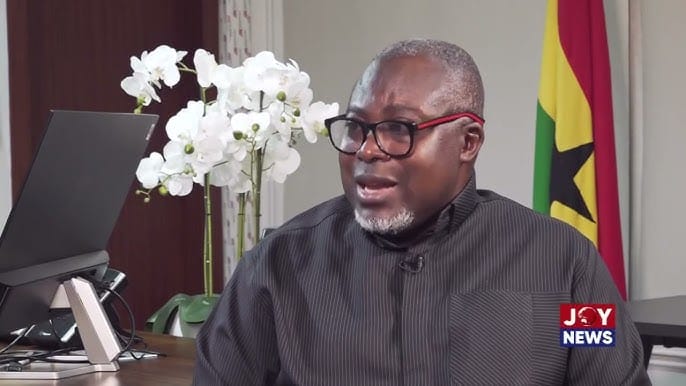
Economist and Professor of Finance at the University of Ghana Business School, Godfred Bokpin, says Ghana’s transition to a cash-lite economy could help reduce the cost of replacin
The report indicates that economist and Professor of Finance at the University of Ghana Business School, Godfred Bokpin, says Ghana’s transition to a cash-lite economy could help reduce the cost of replacing physical currency.
It further notes that he says as more people use digital payments, less cash will be handled daily, reducing pressure on banknotes and helping prolong the life of the country’s currency.
Prof. Bokpin stated digital payments offer benefits beyond convenience. He stated heavy reliance on cash places a burden on the central bank because physical notes wear out with frequent handling.
“The understanding is that, once there is increased uptake, transaction costs will come down and volume will also increase. It helps in terms of inclusion as well. It also helps the central bank when it comes to the cost of replacing physical currency. As people handle less cash and switch more to digital payments, it helps prolong the longevity of the currency. In terms of the benefits, the convenience, the increased output and the welfare benefit are quite huge,” he explained.
Prof. Bokpin was speaking in a yet-to-be-aired documentary, “The Trust Crisis,” ahead of the maiden Digital Economy Forum under the theme, “The Trust Crisis: Why Fraud Is Holding Back Ghana’s Digital Economy.”
The thought-leadership platform, an initiative of Hubtel, will air on JoyNews and Joy FM on Wednesday, July 22, 2026, at 8 p.m.
The forum will bring together regulators, banks, fintech companies, telecommunications firms, security agencies and consumers to examine whether Ghana’s regulatory system is keepng pace with the growth of digital finance.
Currency management is one of the hidden costs of a cash-heavy economy. Banknotes must be printed, transported, stored, secured, sorted and replaced when they become worn out or damaged.
A shift towards digital payments can reduce how often physical notes move from hand to hand, especially in retail transactions, transport, market trading and informal-sector payments.
Ghana’s payment system has already recorded strong growth in digital transactions.
The Bank of Ghana’s 2024 Payment Systems Oversight Report shows that payment service providers processed about 8.1 billion transactions valued at approximately GH¢3 trillion in 2024. The report stated the growth reflected increased adoption of digital payments and stronger oversight of payment service providers.
Prof. Bokpin stated the shift is part of a wider global trend that Ghana cannot ignore. He stated the digital economy is expected to grow faster than the traditional economy, making investment in payment infrastructure necessary.
“That is where the world is heading, and we do not have an option. Economies are increasingly being digitised, especially in the area of payments, and a lot of investment has also been made in infrastructure to enable digital payments. The digital economy, based on digital apps and technologies, is expected to grow faster than the traditional economy. Every projection is heading in that direction,” he said.
But the economist warned that the benefits of a cash-lite economy depend on public confidence in digital financial services.